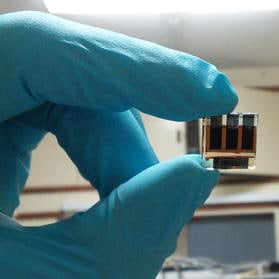
By working to improve perovskite cell efficiency, scientists at Oxford University are creating simpler and cheaper solar cells.
Over the last four years, solar cells made from materials called perovskites have reached efficiencies that other technologies took decades to achieve, but until recently no-one quite knew why.
Since perovskite was first used in 2009 to produce 3% efficient photovoltaic (PV) cells, scientists have rapidly developed the technology to achieve efficiencies of over 15%, overtaking other emerging solar technologies which have yet to break the 14% barrier.
Scientists at Oxford University, reporting in Science, have revealed that the secret to perovskites’ success lies in a property known as the diffusion length, and worked out a way to make it ten times better.
Over the last four years, solar cells made from materials called perovskites have reached efficiencies that other technologies took decades to achieve, but until recently no-one quite knew why.
Since perovskite was first used in 2009 to produce 3% efficient photovoltaic (PV) cells, scientists have rapidly developed the technology to achieve efficiencies of over 15%, overtaking other emerging solar technologies which have yet to break the 14% barrier.
Scientists at Oxford University, reporting in Science, have revealed that the secret to perovskites’ success lies in a property known as the diffusion length, and worked out a way to make it ten times better.